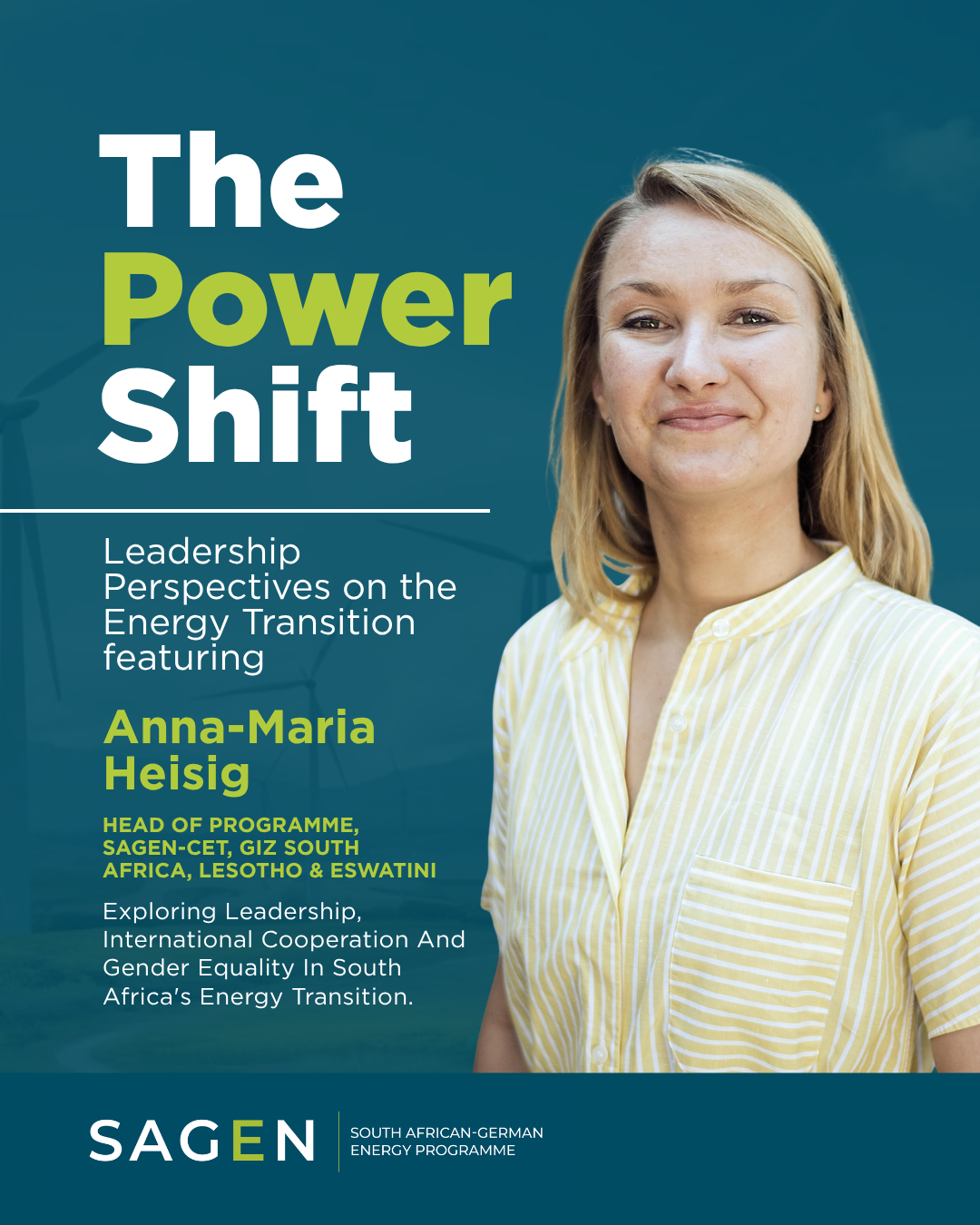
Why is the inclusion of women essential to building a sustainable, resilient and inclusive energy future?
South Africa’s energy transition is not just a technical challenge. It’s a societal one. The country needs to replace roughly 11 GW of ageing coal capacity with around 24 GW of new solar and wind capacity by 2030, while fundamentally restructuring the power sector as Eskom unbundles. A transformation of this scale simply cannot succeed if it draws on only half the country’s talent pool.
Through SAGEN-CET, we work directly with the Department of Electricity and Energy (DEE), NERSA, the National Transmission Company South Africa (NTCSA), and SALGA to build the skills and institutions needed for this transition. We’ve made gender mainstreaming a deliberate, structural part of that work from the outset rather than treating it as an add-on. A resilient energy system needs diverse perspectives at the decision-making table because the impacts of energy policy and infrastructure are often experienced differently by women and men. Inclusion isn’t a nice-to-have alongside the energy transition. It’s essential to getting the transition right.
What progress have you seen in advancing women’s participation and leadership in the energy sector in recent years?
South Africa stands out internationally for having a dedicated, government-owned Women Empowerment and Gender Equality (WEGE) Strategy, first introduced by the former Department of Energy in 2021 and now carried forward by the Department of Electricity and Energy. Through SAGEN, we support the implementation of gender-responsive measures with our partners by helping institutions collect gender-disaggregated data, strengthen organisational development processes, and set concrete, mutually agreed goals for advancing women into senior leadership positions.
We’ve also seen the emergence of dedicated leadership pipelines, such as the C-Suite Women in Energy Empowerment Programme, which combines mentorship, executive development, and media and public visibility training.
Five years ago, conversations about women’s leadership in energy often took place on the margins of sector discussions. Today, they’re embedded in national strategies and institutional partnerships. That shift from advocacy to implementation represents meaningful progress.
Can you share an example of an initiative that has successfully supported women in energy and created meaningful impact?
One encouraging sign is that women’s participation is already strong in several areas. Around 40% of participants in the university and continuing education programmes we’ve supported South African universities to develop are women. That’s an important foundation for future leadership. Building on that momentum, DEE and GIZ, through SAGEN, launched the C-Suite Women in Energy Empowerment Programme. The initiative combines a curriculum tailored to South Africa’s energy challenges with structured mentorship, executive development, media and public visibility training, and a growing alumnae network designed to sustain influence long after the programme ends.
We’re also excited about a new Utility Exchange Programme launching soon, which will pair South African and German peers to collaborate on energy transition topics of mutual interest. Stay tuned.
How can organisations create environments where women are empowered to thrive, lead and contribute meaningfully across the energy value chain?
It starts with treating gender mainstreaming as a system-level priority rather than a side initiative. That means using gender-disaggregated data to identify gaps, strengthening organisational development processes that address structural and cultural barriers instead of focusing solely on recruitment, and creating gender-responsive working conditions, from parental leave policies to safe working environments on-site, that support women throughout their careers.
Leadership commitment is equally important. When senior management commits to measurable goals for women’s representation, as we’ve seen with several of our partner institutions, it changes how seriously the issue is prioritised across the organisation.
Mentorship and sponsorship are just as important as training because access to decision-makers and opportunities for visibility are often the missing links for women who are already technically ready to lead.
What opportunities do you see for women to play a greater role in shaping South Africa’s energy transition?
The transition itself is the opportunity.
South Africa is rebuilding its power sector from the ground up through new institutions such as the National Transmission Company, evolving electricity market structures, a rapidly growing renewable energy and green hydrogen economy, and municipalities taking on greater responsibility for embedded generation and energy management. These changes are creating new roles, new institutions, and new leadership tables that simply didn’t exist a decade ago.
At GIZ, we’re proud to support this transformation. I’d also like to extend a special thank you to my talented, innovative, and dedicated all-female team, whose commitment makes our project initiatives possible every day.