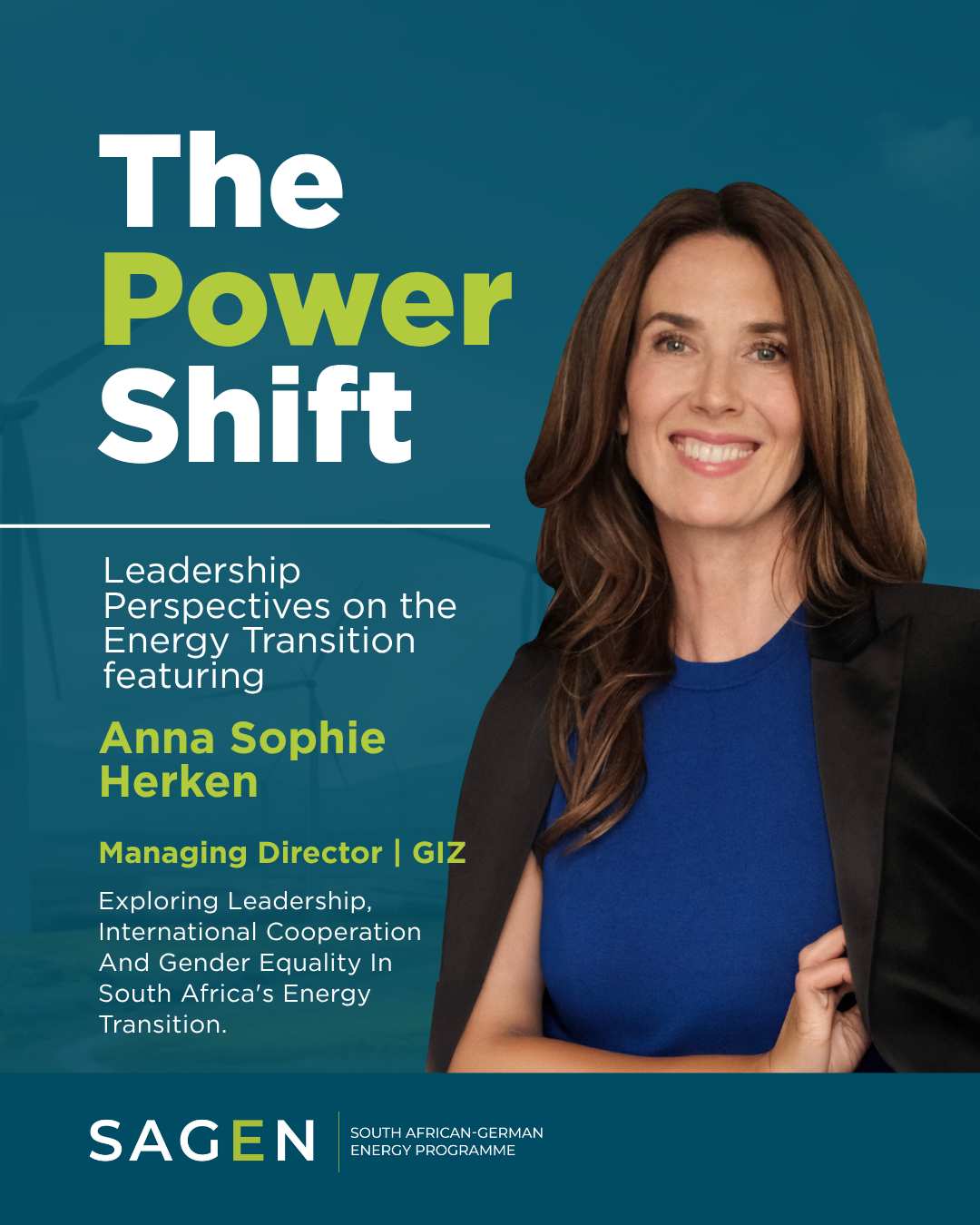
Anna Sophie Herken, Member of the Management Board, GIZ
The global race for clean energy is rewriting the rules of international cooperation. South Africa sits at the centre of that race — holding up to 80% of the world’s platinum reserves, vast deposits of manganese and vanadium, and some of the continent’s strongest renewable energy potential. Anna Sophie Herken, Member of the GIZ Management Board, explains why the German-South African energy partnership is no longer about development assistance and why the transition will stall without women in the room.
Geopolitical context and energy transition: From your vantage point at GIZ, how do shifting global energy alliances, critical mineral competition and supply chain realignment shape the priorities of international cooperation in Southern Africa’s energy transition?
South Africa is not on the periphery of the global energy transition; it is at the centre of it. The country holds around 80% of the world’s platinum reserves, along with some of the largest known deposits of manganese and vanadium, all of which are indispensable for clean energy technologies, from hydrogen fuel cells to grid-scale batteries. At the same time, Germany and Europe are under intense pressure to diversify their energy supply chains and reduce strategic dependencies.
That convergence creates the opportunity for a partnership built on mutual economic interest. South Africa brings irreplaceable resources and a fast-growing renewable energy base. Germany brings technology, expertise and investment networks. When those strengths connect effectively, both countries benefit.
Germany–South Africa cooperation frameworks: How does GIZ, through programmes like South African-German Energy Programme (SAGEN) and the Just Energy Transition Partnership, support South Africa navigate resource governance, energy security and infrastructure investment within this shifting geopolitical landscape?
Infrastructure gets the headlines, but it is the institutions behind the infrastructure that determine whether it works and endures. A power line built without the regulatory framework to maintain it, the technical expertise to operate it, or the governance to oversee it tends to become a liability rather than an asset.
GIZ’s comparative advantage is not financing infrastructure itself. It is helping build the institutions that allow infrastructure, investment and markets to function over the long term. Through programmes such as the South African-German Energy Programme (SAGEN) and the Just Energy Transition Partnership (JETP), GIZ works alongside government institutions, regulators, municipalities and industry to strengthen electricity market reform, modernise grid planning, improve regulatory frameworks and build technical capacity across the sector. More than 3,000 energy professionals have been trained through SAGEN alone. That represents a measurable shift in institutional capability, and it is what gives private investment the confidence to follow.
Delivering the energy transition: Can you share an example of a GIZ-supported intervention that had significant impact on South Africa’s energy security or resource-strategic positioning, for example in critical minerals, grid infrastructure or regional interconnection?
One example illustrates the impact particularly well: through SAGEN, more than 19,800 embedded generation connections have been registered across more than 50 municipalities — exceeding the programme’s own target. Those connections represent households, businesses and municipalities generating their own electricity from renewable sources and feeding surplus into the grid. Each one required navigating registration processes that were previously opaque, slow or simply inaccessible to smaller players. That is the kind of institutional unblocking that GIZ is built for. We do not build the solar panels. We work with municipalities to put in place the processes, the technical expertise and the regulatory clarity that allow the panels to get connected and counted. The cumulative effect is a more competitive, investable electricity sector — and a reminder that resilient energy systems depend not only on infrastructure, but also on strong, inclusive institutions.
Leadership & Inclusion: Within these high-stakes cooperation processes, what role does women’s leadership play, both within GIZ and among South African partners, and how does GIZ ensure diverse leadership is positioned to shape these agendas?
Women remain significantly underrepresented in the global energy sector, making up just 32% of the renewable energy workforce and an even smaller share of senior leadership. The decisions being made right now about grid architecture, mineral governance, regional interconnection and energy diplomacy will shape economies for decades. Keeping women out of those decisions does not just fail them individually; it weakens the quality of the outcomes. Within GIZ, we embed gender considerations across our programmes rather than treating them as a parallel workstream. We invest in initiatives such as the Women in Energy Leadership Programme to actively develop and position women to lead. The goal is not only representation as an end in itself — it is stronger institutions, better decisions and a more resilient energy system. South Africa cannot afford to leave that talent on the table.
Future opportunities for women in energy leadership: Looking ahead, what opportunities do you see for German-South African cooperation and for women in leadership to shape South Africa’s strategic positioning in energy diplomacy, resource beneficiation and continental energy integration?
The opportunity lies in local value addition: moving South Africa from exporting critical raw minerals to processing them locally, manufacturing components and building regional value chains that compete in the global clean energy economy. Ultimately, beneficiation is about ensuring that more of the value created from South Africa’s natural resources is generated within the country and the region. That shift would create skilled employment at scale, strengthen industrial competitiveness and enhance South Africa’s leverage in global energy diplomacy. Seizing it requires three things to come together: strong institutions that can govern resource extraction responsibly, investment frameworks that attract and retain capital in processing and manufacturing, and a pipeline of diverse, capable leaders, including and especially women, who can negotiate and deliver on that agenda. German-South African cooperation is well positioned to support all three. The question is whether we move fast enough to match the pace of global competition.