Why is the inclusion of women essential to building a sustainable, resilient and inclusive energy future?
Including women strengthens innovation, improves energy access, and helps ensure that policies and technologies reflect the needs of all communities. This makes the energy future more sustainable, resilient and inclusive. Women make up 49.7% of the world’s population. In Sub-Saharan Africa, women account for 50.2% of the population, while in South Africa, they account for 51.1%. Therefore, there can be no meaningful and sustainable future if the perspectives and talents of half the population are excluded. Doing so undermines both equity and the effectiveness of policy development and implementation.
Women bear the brunt of energy poverty in Africa. Their inclusion promotes equity and justice by helping ensure that solutions address the real needs of households and communities. It also helps ensure that innovative and sustainable solutions contribute to building a strong foundation for a sustainable, resilient and inclusive energy future.
From your perspective, what progress have you seen in advancing women’s participation and leadership in the energy sector in recent years?
Women’s leadership in the energy sector is advancing, particularly in governance and advocacy. However, the sector still faces bottlenecks at the middle-management level and uneven representation across technical roles. Women have taken on leadership roles in both the private and public sectors. Recent examples include Ms Precious Edwards, Head of the IPP Office in the DEE; Dr Phindile Masangane, who was CEO of the Petroleum Agency of South Africa; and Ms Tebogo More, who was CEO of Avon and Dedisa Peaking Power, plants with a combined installed capacity of 1 GW. These examples reflect the growing traction of women-focused training, webinars, conferences and mentorship programmes in the sector.
Board representation in public-sector entities appears to be moving towards reflecting population demographics, with six of the 11 members of the NTCSA Board being women. However, more needs to be done to support women’s advancement into leadership positions.
Can you share an example of an initiative or intervention that has successfully supported women in energy and created meaningful impact?
The South Africa Public Buildings and Infrastructure Project (Energy Efficiency in Public Buildings and Infrastructure Programme, “EEPBIP”), implemented by GIZ in partnership with South Africa’s DEE, finalised a comprehensive Gender Equality and Social Inclusion (GESI) Analysis and Action Plan in October 2025. This framework aims to ensure that the benefits of energy-efficiency interventions reach all South Africans, with a particular focus on women, young people and persons with disabilities (PWDs). A flagship outcome of this work is the establishment of the Municipal Women in Energy Efficiency Forum (MWEEF). The MWEEF is designed to amplify women’s leadership in reducing emissions and building climate-resilient communities.
The EEPBIP’s impact is far-reaching: it led to the creation of the MWEEF, introduced a mandate that 60% of tenders for energy service companies go to firms owned by women, young people and PWDs, and embedded GESI principles in procurement, financing and implementation.
Source: Mitigation Action Facility
How can organisations create environments where women are empowered to thrive, lead and contribute meaningfully across the energy value chain?
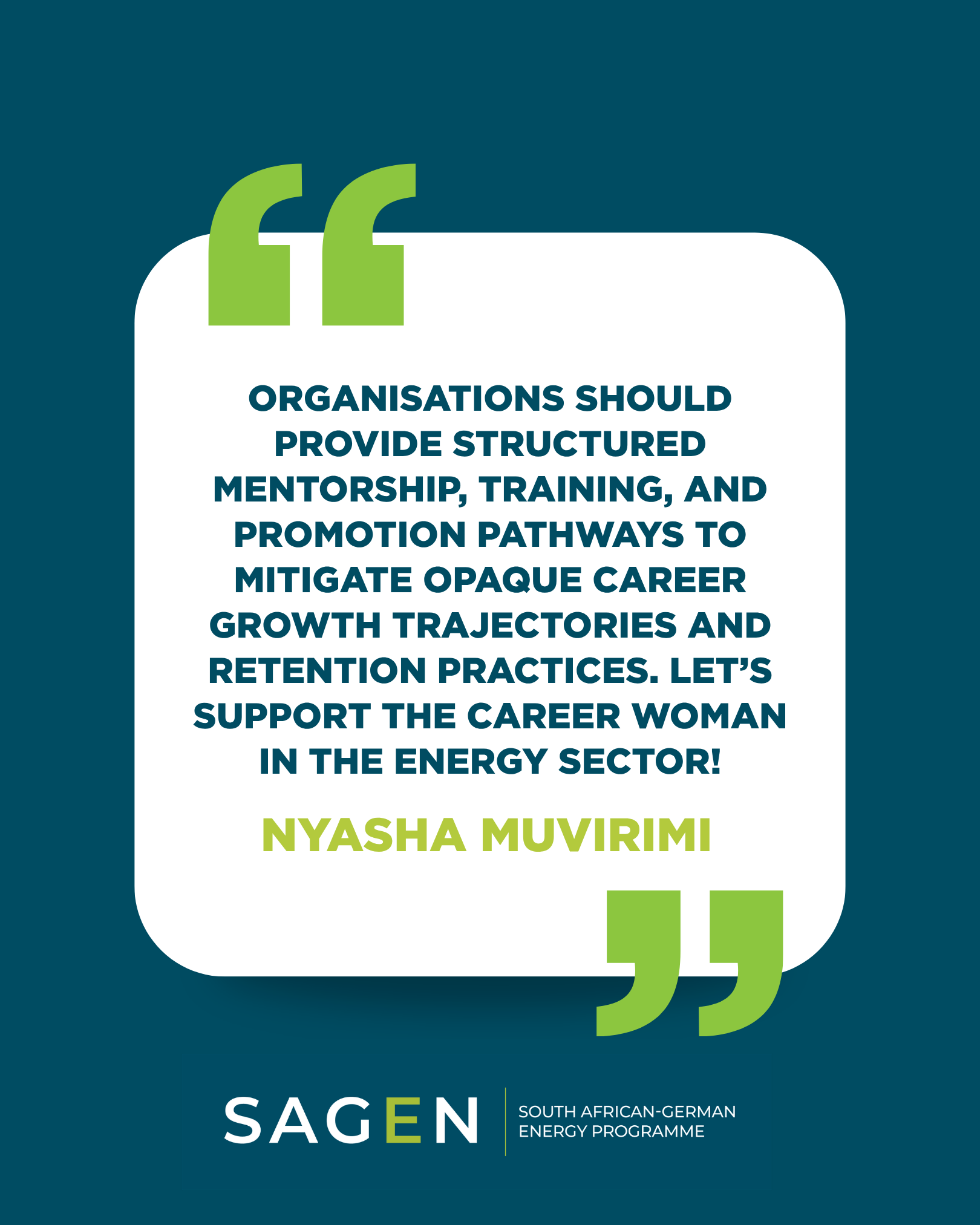
In addition to developing inclusive policies, such as gender-diversity guidelines, organisations could provide structured mentorship, training and promotion pathways. These measures could help address opaque career-progression and retention practices.
What opportunities do you see for women to play a greater role in shaping South Africa’s energy transition?
Women should focus on manufacturing components across the sector and providing specialist services, such as advisory, operations and maintenance services. Women can play transformative roles in manufacturing across the sector, supplying inputs to the energy value chain—not only as workers, but also as innovators, entrepreneurs and leaders shaping industrial growth. Their involvement strengthens supply chains, drives inclusive growth and helps ensure that the energy transition is socially sustainable.
In particular, women should be at the forefront of establishing and leading manufacturing enterprises that produce critical inputs, such as turbines, solar panels, transformers and cabling. In the nuclear power sector, Women in Nuclear South Africa has empowered female professionals to establish consultancies and SMEs that supply nuclear-related services, demonstrating that women can thrive in both technical and leadership roles.