The camera switches on. The red recording light blinks. Now what?
For many leaders, this moment can feel unfamiliar. Yet in today’s energy landscape, executive leadership increasingly plays out in public spaces as much as in boardrooms.
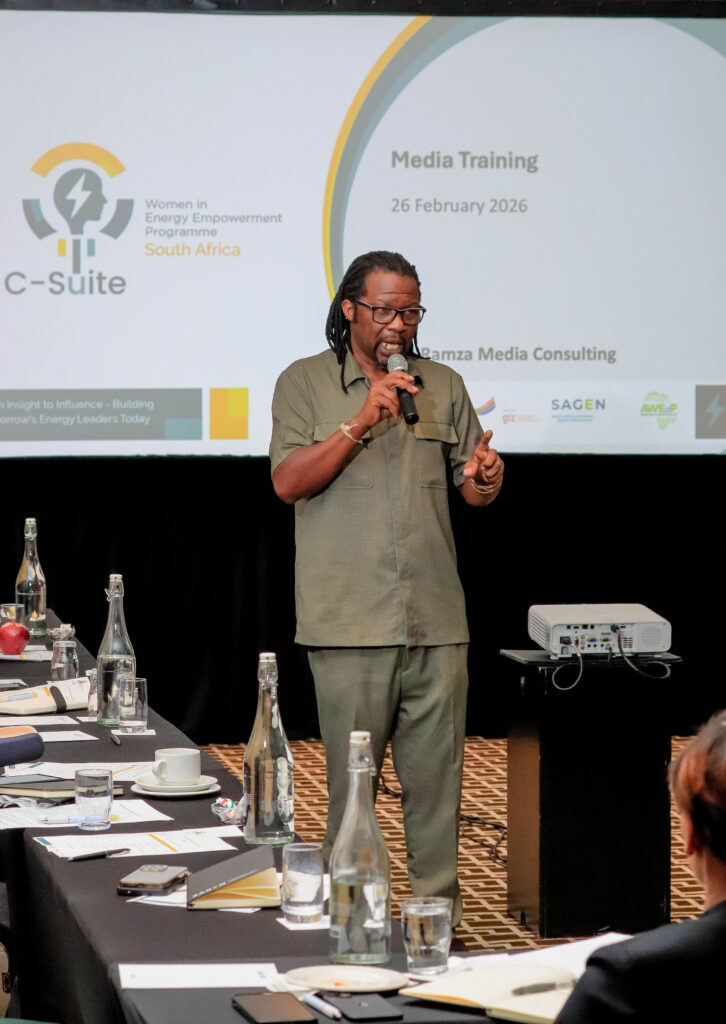
This week, the C-Suite Women in Energy Empowerment Programme Mentees stepped into that space during a dynamic media training session facilitated by media strategist Oupa Setale, with insights from journalist Naledi Moleo. The session focused on practical tools to navigate interviews, panel discussions, and public engagements with clarity and confidence. But this training was about more than handling media.

Why Voice Matters in the Energy Transition
South Africa’s energy transition is complex, visible and often debated. Leaders must be able to explain reforms clearly, engage diverse audiences, and shape conversations about the future of the sector.
For women in executive and senior leadership roles, visibility and influence are critical. Representation in decision-making must be matched with the confidence to engage publicly and authoritatively. That is where media training becomes strategic.
Advancing Gender Mainstreaming in Practice
The training forms part of the South African–German Energy Programme Capacities for the Energy Transition (SAGEN-CET), implemented by GIZ in partnership with the Department of Electricity and Energy (DEE). Through this partnership, targeted support is being provided to advance gender mainstreaming in the energy sector, aligned with the Women Empowerment and Gender Equality (WEGE) strategy. The C-Suite Women in Energy Empowerment Programme strengthens the leadership pipeline for women through structured mentorship, executive development and strategic visibility platforms.
Media training adds an essential layer: strengthening voice, influence and narrative leadership.
The Bigger Picture
Gender mainstreaming is not about compliance. It is about reshaping systems so that inclusion becomes standard practice.
For DEE and GIZ, the shared objective is long-term institutional change:
- More women in decision-making roles
- Stronger leadership pathways
- Inclusive implementation of energy reforms
- An energy sector that reflects the diversity of the country it serves
An inclusive energy transition does not happen by chance. It happens through deliberate, practical action. Initiatives like the C-Suite Programme are part of that action, ensuring inclusion is not just an idea, but a lived practice.
For more information about the C-Suite programme, please visit: C-Suite Women Development Programme – AWEaP Africa